Search This Blog

Showing posts with label culture. Show all posts

Friday, March 31, 2023

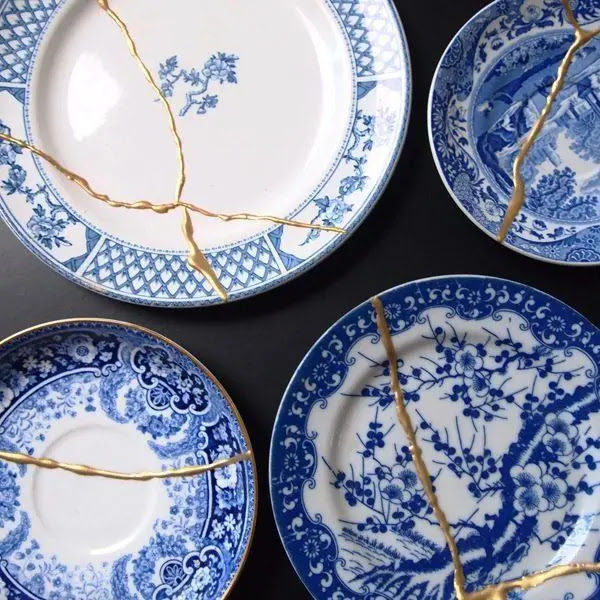
Kintsugi

 Kintsugi is a way of mending broken pottery in Japan with lacquer dusted with gold or silver powder. It is recognizing, allowing, acknowledging and celebrating a crack or what might be seen as a flaw, but is an imperfection that joins all humanity... we are all imperfect which is part of what MAKES us human. I believe we are in this human life to grow and expand which requires some kinks along the way, and maybe even some suffering... so our suffering can be purposeful, which is encouraging and reminds me to be with suffering so that it is not wasted. It contributes to my heart's expansion and compassion. 


One nice excerpt from this article:

Today, extremely strong and barely visible epoxies and other repair compounds exist – but none add value to the pottery the way kintsugi does. If the perfect repair is done and the pottery looks as good as new. That is well and good, but it is also no better than a brand new mass produced item.

Again, same for humans. With age comes experience. With failures comes wisdom. Instead of hankering for a clean slate, forever wishing to take back one’s old mistakes, grasping for something different, we should instead highlight ourselves, flaws and all in large bold gold letters and become more beautiful for it.

In doing so, by practicing the philosophy that kintsugi so perfectly encapsulates, we find that ourselves and our lives suffice and is innately wonderful.


Monday, August 10, 2020

Honoring Land Ancestors, The Osage

Today, walking in Overland I noticed a sign that mentioned an old Indian burial ground... I wandered behind a church and said a prayer on the grassy slope there... honoring ancestors. I decided to research the native American, indigenous people of the st Louis area...

The largest and most powerful tribe was the Osage.

Here we see an Osage warrior.

"The men are tall and perfectly proportioned. They have at the same time all the physical qualities which denote skill and strength combined with graceful movements. . . .

by Charles Evret de Saint-Me

". . . their ear[lobe]s, slit by knives, grow to be enormous, and they hang low under the weight of the ornaments with which they are laden. There is a complete lack of beard and eyebrows on their faces, for they carefully pull out the little hair which happens to grow there.

"Their calm, dignified faces show great shrewdness; there is something soldierly and serious about the expression. Their hair is black and thick. The Osage shave their heads, except for the top, from which two strands of hair branch off and grow straight back to the occiput, where they form a tuft which falls to the lower part of the neck; between these strands grow two braids, the beauty of which consists in their length. . . .

"The [Osage Indians] seldom go out without painting themselves; the colors they use are, first, vermillion, then verdigris [greenish-blue], and then yellow, which they buy from the trader; lacking these, they use ochre, chalk, or even mud.

"The Osage always paint red that part of their head around their hair, the eye-sockets, and their ears; these are the national colors, the war-time paint. The other colors, indifferently put on the other parts of their bodies, depend upon their individual fancy."

-Victor Tixier, physician, 1839

I am moved by the discipline, ritual and self respect that comes through these images and writings.  I long for the days when tribal earth- and ancestral-honoring traditions connected people to each other, the past and the land. I long for a deep sense of respect for oneself and for the land as a way of life that is shared in community.


by George Catlin


#osageindian #osagewarrior #missourinative #nativeamerican #nativelands

Thursday, July 9, 2020

On Cancelling People

When Amy Cooper was videoed in Central Park saying to Chris Cooper, "I'm going to tell them I am being threatened by a black man," I kept wondering, WHAT did he say to her that triggered this reaction? I finally learned it today when I went searching the internet. In the statement from Amy, she says, "When Chris began offering treats to my dog and confronted me in an area where there was no one else nearby and said, 'You're not going to like what I'm going to do next,' I assumed we were being threatened when all he had intended to do was record our encounter on his phone."
Here is the summary that was reported over and over in the media: "A Black man asked a white woman to leash her dog in Central Park, as rules required. She refused. Then she called the police to say she was being threatened." And regarding the moments before filming began, "After he asked her to leash the cocker spaniel, the two exchanged words."
After that we got to hear in detail all that she said on the emergency call. (I assume everyone reading this has watched that video, and maybe some interviews with Chris Cooper.) She had assumed that what he was "going to do next" would be physically harmful to her because he was a black man? And she chose to use her whiteness to threaten him without bothering to communicate with him, human to human.

But I was like, "Well WHAT did he say to her?" Not that it would erase the racism that was plain to see, but why was this not in the news report? In an effort to remain connected to our common humanity I felt we deserved to know the whole story and when I learned what he said (according to her), I gained a glimpse of what could have put her into the fear response, albeit a racist one.
She has lost her job, home and reputation and seems to have become a pariah.

I heard a journalist yesterday say that we have a "cancel-society." We cancel people, kind of like a Black Mirror episode. Kevin Spacey, for example has been "canceled." Are we going to demonize and erase people to the extent they cannot actually be in society any longer? I want us to have regenerative processes for healing and learning in our society. I want us to stop throwing people away on one hand while we do the good work for justice and fairness on the other.

True nonviolent communication calls us to heal together, not put a distance with those that are harming and needing to grow... from what I read, she sounds open to growing.
I celebrate that Chris Cooper himself is open to forgiveness and reconnecting; in another article: "Asked if he’d accept her apology, Christian Cooper told CNN he would 'if it’s genuine and if she plans on keeping her dog on a leash in the Ramble going forward.'"
Excerpts from news article found here.

Saturday, February 11, 2017

The Myth of Psyche and Cupid

I found an old copy of "SHE: Understanding Feminine Psychology" by Robert A. Johnson and was skeptical that it would help me learn about feminine psychology, but I read this delightful account of a myth that actually does reflect some experiences I have had with men in a way that was quite comforting and reflective of some past events that helped me feel less self-blaming, and more accepting of the reality of some men's fears and blocks, and my own expectations and desires. 

Also, Robert Johnson helped me come to a new appreciation of myth as a conglomeration of a society's view of roles and existential perception. He says:

"A myth may be fantasy; it may be a product of the imagination, but it is nonetheless true and real. It depicts levels of reality that include the outer rational world as well as the less understood inner world within the psyche of each individual... A myth is a product of the collective imagination and not of scientific or rational development, but it is profoundly real. Because of its manner of development, through years of telling and refining by countless people, it carries a powerful collective meaning." 

So this struck a new chord for me and after reading this myth realized that this myth represents a collective experience of generations of people of a certain major culture and for that reason represents reality in a period of time for so many... I am left to wonder, if we had relied on oral tradition instead of written communication, how would this myth have evolved as we evolved in relationships with each other? Would the current account of the myth be different if we had not written it down?


Saturday, January 16, 2016

Sick Dogs of Bodhgaya

I received amazing news yesterday and am feeling so happy and grateful! A sick dog in India that I spent 2 days trying to capture to take to hospital has been treated for cancer and released by Dogs of Gaya


I had stayed in Bodhgaya for weeks and saw him 4 times on the road sitting helpless, sad and weak with a terrible open wound around his testicle area that he continually licked. When I heard about an animal hospital (Maitri Foundation) a few km away, I went there to get help. After pleading, phone calls and the promise of donating, two men took me back to town in their dog-catching jeep to find the dog and bring him for treatment. That day we couldn't find him.

The next morning I found him and took him breakfast and called the men back to meet me with their jeep. But the dog ran and ran in fear.


One man chased and chased for an hour, and I ran around town looking for the man chasing the dog. One nice tuktuk driver helped me get around (he had taken me to the dog hospital the day before, waited with me that morning for the jeep and men, gave me a tea... he was eager to help with my dog rescue). I was in and out of the tuk tuk, and in and out of the hospital jeep. I tried to coax that fearful sick dog. We had to give up for the day.

I was leaving town the next morning. I felt worried about this dog. I named him Balaram! I figured that might help the Maitri Foundation want to help this pet even after I left town. Why was I so attached to getting help for this dog?

Yesterday I messaged Dogs of Gaya (an NGO that helps dogs on the streets in that area) and learned that they got the dog to the annual Kagyu Monlam Animal Medical Camp where they fixed an infected tumor he had. The dog is now healthy, playing, and happy to be pet and cuddled!

So many dogs in India are forced to live at the literal margins of society. They can't live in the road, or will be run over, and are eschewed from the sidewalks by people doing business there. They must literally live on that line where the road meets the edge. They live on this thin line of nothingness, hoping for a scrap of food, and avoiding the cars and scooters that drive within inches of their bodies. Many do get hit or run over and suffer with the injuries or die. 

I am so very glad and grateful to the amazing things Dogs Of Gaya is doing for a very needy population of loving emotional beings who are neglected. I saw some people shouting at them or hitting them with sticks, but mostly they are ignored. Luckily many people do get rid of old leftovers by leaving them on the ground for the dogs or cows. Interestingly, dogs usually stay in the same area to live. This dog stays in front of the Thai temple on the main road.

When I would walk and see stray dogs, I would bend down and talk to them in a friendly way. Most would look up and wag their tails a bit, looking hopeful. I would pet those dogs, and they would stand up and get all happy. Most want some love and attention. After all they are domesticated animals, not meant to be living out on their own alone. If they did not wag the tail I would leave those dogs alone. I saw so many mangy and undernourished dogs. The weaker ones will lose opportunities to eat food and are treated even worse by people, being seen as a source of sickness.

Dogs of Gaya really represents the important Compassion in Action that His Holiness the Dalai Lama talks about! 

Please donate -- www.dogsofgaya.org

‪#‎bodhgaya‬ ‪#‎mahayana‬ ‪#‎dogrescue‬ ‪#‎dogs‬ ‪#‎india‬‪ #‎animalrescue‬ ‪#‎animallove‬ ‪#‎compassion‬

Friday, January 15, 2016

I read "Mother Night" by Kurt Vonnegut

I finished reading Mother Night today. I took it from my room in Mom’s house… it was amazing writing by a guy who was a prisoner of war in Dresden when it got hit. He had to excavate burned bodies after the firestorm that Churchill ordered on that city that had a bunch of refugees from other cities that were carpet-bombed in an attempt to wear down civilian morale to stop Hitler’s advance around Europe/Asia.

How awful! To bomb civilians as a tactic of war; isn’t this a first form of terrorism in our western history? See his book, Slaughterhouse Five, one of his most famous.

I read an interview with Kurt Vonnegut which was amazing. He said he wished everyone in the US would read more books and write book reports. So I decided to write a little book report for him, may he rest or live on in peace and enlightenment (he died in 2007 while living in New York).

I want to start by saying I loved this book. Vonnegut has a genius droll sense of humor. A bit cynical in a fun clean way that helps us develop our own opinions. This book caused me to delved into WWII documentaries on Netflix. I guess I should be grateful, history is good to learn... better than learning what the damn Kardashians or maids of Downton Abbey are doing, probably. 

So the book is about an American-born guy, Howard W. Campbell, Jr., who moved to Germany with his parents at age 8 or 10 and became a propaganda announcer on the radio while sending code messages to Americans with his different intonations and speech patterns. The book didn’t really get into that so much… but it was about the character’s indifference toward the war and to either side of the warring factions. He just cared about his beautiful wife Helga and the “nation of two” that they created in their big double bed. That was the center of his world, and everything else was just puppetry. But he became a famous German war criminal across the world, and was not keen on being caught for it for a while.

Outside of his interest in the “nation of two” with Helga, he was driven by curiosity in the rest of his life. Not by beliefs, attachments or hatreds. He didn’t seem to have opinions on anything, and just listened to people with a reflective, supportive simple curiosity.

He wrote about one friend, “I was very fond of you, to the extent that I could be fond of anybody.”

Favorite passage in the book: page 162:

I have never seen a more sublime demonstration of the totalitarian mind, a mind which might be likened unto a system of gears whose teeth have been filed off at random. Such a snaggle-toothed thought-machine, driven by a standard or even a substandard libido, whirls with the jerky, noisy, gaudy pointlessness of cuckoo clock in Hell.

The boss G-man concluded wrongly that there were no teeth on the gears in the mind of Jones. “You’re completely crazy,” he said.

Jones wasn’t completely crazy. The dismaying thing about the classic totalitarian mind is that any given gear, though mutilated, will have at its circumference unbroken sequences of teeth that are immaculately maintained, that are exquisitely machined. Hence the cuckoo clock in Hell – keeping perfect time for eight minutes and thirty three seconds, jumping ahead fourteen minutes, keeping perfect time for six seconds, jumping ahead for two seconds, keeping perfect time for two hours and one second, then jumping ahead a year. 

The missing teeth, of course, are simple, obvious truths, truths available and comprehensible even to ten-year-olds, in most cases. The willful filing off of gear teeth , the willful doing without certain obvious pieces of information. That was how a household as contradictory as one composed of Jones, Father Keeley, Vice-Bundesfueherer Krapptauer and the Black Fuehrer could exist in relative harmony. That was how my father in law could contain in one mind indifference toward slave women and love for a blue vase.

That was how Rudolf Hoess, Commandant of Auschwitz, could alternate over the loudspeakers of Auschwitz the great music [symphonies] and calls for corpse-carriers [that jewish prisoners volunteered to do].

That was how Nazi Germany could sense no important differences between civilization and hydrophobia.

That is the closest I can come to explaining the legions, the nations of lunatics I’ve seen in my time. And for me to attempt such a mechanical explanation is perhaps a reflection of the father whose son I was. Am. When I pause to think about it, which is rarely, I am after all, the son of an engineer.

Since there is no one else to praise me, I will praise myself – will say that I have never tampered with a single tooth in my thought machine, such as it is. There are teeth missing, God knows – some I was born without, teeth that will never grow. And other teeth have been stripped by the clutchless shifts of history.

But never have I willfully destroyed a tooth on a gear of my thinking machine. Never have I said to myself, “This fact I can do without.”

His Helga was killed in the war but it seemed for a few moments that she was saved, for she found him in New York where he was living under the cover of the busy confusing place of that city. She admitted to him later that she was in fact Helga’s sister, Resi, who was extremely attached to Mr. Campbell. He carried on with her as with his wife, and seemed to lover her in his way. But she killed herself with a cyanide pill when authorities came to the house of spies and operatives that he was mixed up in. Their little friendly group of people who all admired Campbell was getting broken up. People who admired him including Russian spies (Resi was one of them). She had a singleminded attachment to him and departed saying he had no capacity to love anymore, he just had “curiosity and a pair of eyes.” He was sad to lose the time with her, but was not attached to her specifically.

He was the epitome of passive. He got upset and violent one time (in his whole life!) when his prime hater and pursuer -hiding in his ransacked apartment - tried to kill him. But even then he explained away his comparison of Bernard B. O’Hare to the sounds and movings of a rat. But then clarified:

I do not mean to slander him by associating the sound he made with the sound of a rat. I do not think of O’Hare as a rat, though his actions with regard to me had the same nagging irrelevance as the rats’ scrabbling passions in my attic walls. I didn’t really know O’Hare and I didn’t want to know him. The fact of his having put me under arrest in Germany was a fact of submicroscopic interest to me. He wasn’t my nemesis. My gave was up long before O’Hare took me into custody. To me, O’Hare was simply one more gatherer of wind-blown trash in the tracks of war.

That guy accused Howard of being pure evil, and had obsessed his whole life about capturing Campbell. All the while Campbell never gave this guy, or much of anything else, a second thought. Campbell sort of lived in the moment.

That O’Hare guy vomited down the stairwell, and this disgusting mess kept Campbell from going out the building… but it was also the apartment of a Dr. Epstein on that landing that made him freeze and not move. He wanted to be captured for being a spy. He wanted to be turned in. Epstein was a jew and must want to help capture a known German war criminal. 

The only thing that could save him in the case was if there was proof that he had associated with an American spy agent. He was shipped off to Israel (he repeatedly reminded us that he was in that prison of his own free will). The Haifa institute was providing him with all sort of research and copy services. He seemed appreciative. He was appreciative of so many on all sides, of all ilks. He didn’t really hate anyone, but had a humorous lack of attachments to beliefs, morals, or sense of a correct life. If anyone was hurt due to his actions on the radio, he was oblivious and uninterested. 

An example of Vonnegut's funny ironic humor was an exchange that our hero Campbell had with Adolf Eichmann while walking down the hallway of the prison. The guards assumed they would want to talk to each other. Eichmann did not recognize Campell (though Eichmann had danced with Campbells' wife at a party in Germany) but when told who he was, asked Campbell for writing advice. "Should one get an agent?"

When released to freedom at one point, he froze standing in the street, not wanting to move or go anywhere. “It was not guilt that froze me. I had taught myself never to feel guilt”

It was not a ghastly sense of loss when his friends were taken away and Resi died; it was not a loathing of death; it was not heartbroken rage against injustice (“one might as well look for diamond tiaras in the gutter as for rewards and punishments that were fair”); it was not the thought that he was so unloved. What froze him, after being released from the house raid, was being released by his Blue Fairy Godfather (the American Spy Frank Wirtanen who appreciated his ‘service’) was the lack of curiosity.  It had flickered out.

“What had made me move through so many dead and pointless years was curiosity.”

In the end, while in the Israeli prison cell, he decided he would kill himself the next day after receiving a letter from his American agent who proclaimed his innocence as a German war criminal, and who in fact, “at personal sacrifices that proved total, became one of the most effective agents of the Second World War.”  

Several time in the book we see this guy Frank Wirtanen saying that Campbell was such an important American spy, which seemed a ridiculous claim about a playwright radio personality who so dispassionately followed simple orders to talk and cough in certain ways while writing plays on the side that actually did become quite popular.  So in the end, he was just a playwright who loved making love to his wife. 

#vonnegut #WWII #blackhumor #nazigermany #mothernight
Tuesday, March 17, 2015

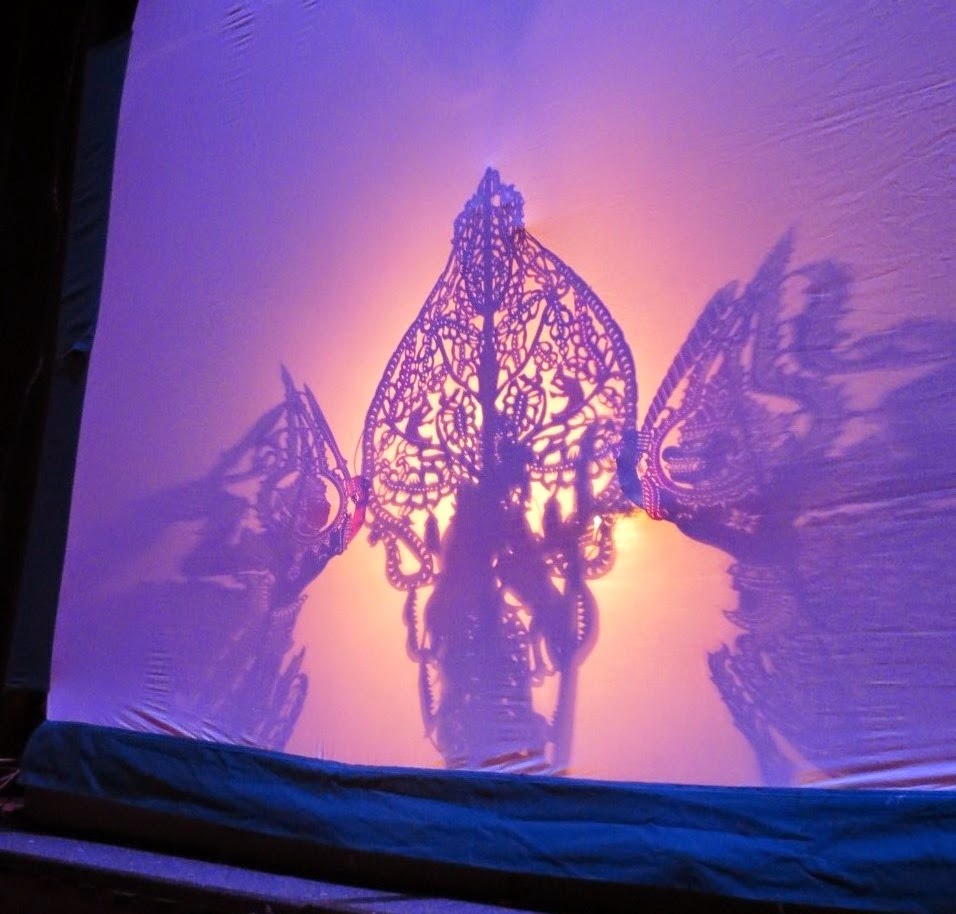
Malaysian Wayang Kulit Shadow Puppets

Last weekend I experienced my first Malaysian shadow puppet show in Gainesville, Florida, seeing “Wayang Kulit: The Shadow Play of Kelantan”, Florida.  The troupe was traveling in the USA giving a sampling of the art with a one hour demonstration. They are a group of villagers from the state of Kelantan that borders Thailand where much traditional Malaysian music originated. The shows are typically 3 to 5 hours long, and portray stories from the Ramayana,  This evening's tale was of Lord Rama's courtly attendants discussing security of the palace, and then Ravaan coming in to steal Lord Rama's wife, Sita. 


When I entered the space, there were rows of seats to the right, and a red carpet for floor-sitters to the left... just in front of the screen. I saw my friend Anna P. there, and I wanted to be there with her, right next to the stage. When I sat down, I looked up and saw the screen, rows of puppets, and a young Malaysian drummer child sitting on the stage behind the screen. I smiled at the whole scene with child-like joy! I waved at him with a little wave and a big smile, feeling so excited that I was going to experience this traditional, original, unbroken lineage of ritualistic honored sacred art of telling religious stories for the enlightenment of the community they live in. He smiled back. As we all waited for 10 or 15 minutes, we kept looking at each other... and smiling. There was a very old man directly behind him (see pic) that we later learned is one of the masters, in his mid 70s. 


There was a second projection screen to the left of the puppet screen where a few sentences were listed in English to explain each scene.  They were quite general and did not reflect dialogue or drama. 


The show opens up with the tree of life and two celestial swordsmen protecting the tree of life. In Malaysia there would be prayers and rituals to start the show.  


As I watched these large images moving on the screen, I was so curious about how the puppeteers were moving the puppets back there. Were they in the floor? Why couldn't I see their hands or arms? The projection on the fabric was so sharp. 

 I was mesmerized by the drumming... there was a flute that was like a snake charmer. It was mesmerizing actually... Later we heard that after hours, some viewers go into a trance. It might be part of this spiritual art.

There is one puppeteer called a Tok Dalang (puppet master) who maninpulates all the puppets and says all the dialogue. Wayang means 'theatre,' and kulit means 'skin.'  The large puppets are made of buffalo skin, and I think a stick of horn is a rib doing down the length of each puppet giving it the strength to stand up to the movements.

I was craning my head to see behind the screen to figure this out... I was in awe of all the colorful puppets... The director was sitting on the edge of the raised stage where the musicians were sitting behind the puppeteer. He signaled with his finger, beckoning me to come back there. I turned round to see if he was speaking to someone else. There was nobody else... He beckoned again... I pointed at myself, he nodded, yes, come... I stood up halfway and went to where he was, and he said "You don't have to sit in one place. You can move around." 

So I kneeled there in total awe of the spectacle I was witnessing, and the incredible light and color of the Tok Dalang, his puppets, the light hanging in front of his face. the rows of puppets next to him. The musicians. I was heartbroken that no photos were allowed. Would I be able to find this on google, I wondered?  But I just enjoyed, and watched with awe as the puppeteer grabbed a puppet from a block of florists' green styrofoam. A palace perhaps... and he'd stab it into the styrofoam in front of him with quick deft confidence, because he had two other puppets that needed to get fighting! Those, he would swoosh across the screen, pressing the top to the screen, and swining the bottom part a little more so they moved in an arc across the screen, with the top more sharply projected than the bottom. It created an amazing movement affect for the audience, and was pretty simple... 

I stayed there a while and a few other folks from the floor came over, Anna first... then Kathy S. come from the seats to come see. More people came. I watched as my 13 year old drummer friend helped the puppeteer find the right puppets when needed from the puppet block in front of him... I never got to talk to my drummer friend... his older brother and mother are also musicians.


So while there is one puppeteer, there are 8 musicians (4 masters, and 4 young students ages 13 to 24 or something). They were playing barrel drums, gongs, cymbals and an oboe. 


I went back to watching from the front. I loved the music. Can I find a recording of that? I thought about making shadow puppet shows with elephant stories. I wondered if American puppeteers were ever producing these traditional shows to keep this art alive.  


After the show, the director talked, and the assistant director, a Malaysian woman answered most of the questions. They were so relaxed and nice, staying with us for almost an hour, answering questions and discussing. I asked about the tree of life coming back during some times in the play. They said it was used to represent the forest. I asked about other puppeteers doing this work in our out of Malaysia. There are only 3 troupes left doing it and no artists outside Malaysia doing it like this.  


I asked about the relationship between the Tok Dalang and his puppets... I wanted to know about this man's personal experience. The director answered in general that there is a relationship... the woman answerd that the puppets are a community and all travel together, even if the won't all be used in a show. And some are there and never used at all but stay with the group. They showed us a puppet that was almost 200 years old. They talked about the main master that was so famous that died not too long ago. 


I wanted to show these puppets to people. I wanted to make a show with a good story, and singing that people would enjoy while seeing the artistry of these puppets. I wanted to have ritual and the tree of life in the show, to create awareness, consciousness and reverence for all that we do.  


Wednesday, November 12, 2014

Wage Slave Society


"Every effort under compulsion demands a sacrifice of life energy." - Nikola Tesla, quoted in Waking up: Freeing Ourselves from Work, a book by Pamela Satterwhite.


I have noticed the robotic routines people engage in during the week, with weekdays consisting of rushed morning getting selves and kids ready for work and school at crazy early times... coming home or doing afternoon activities designed by others to "improve the self," grabbing mail and newspapers, changing, cooking, eating, watching some tv, or reading a novel or checking out some social networking... and going to bed, and repeating the next day. The weekends are full of home improvement, car maintenance, yard work, going to games, cleaning the big house with all it's stuff that needs to be cleaned... 

Someone told us that we need big homes with big yards, and big cars to take ourselves to long-working hours in jobs where others tell us when to work, and allow a few weeks a year which we use for a "getaway" vacation... giving us benefits that pay for exorbitantly unaffordable insurance.

This is the situation for the masses of people who are workers in large companies, and these companies are getting bigger, so that workers are farther and farther from those making decisions and they can't see effects decisions have on people, just how decisions affect numbers.

Capitalist society is structured such that most people are either unemployed or "wage slaves." This leaves little time for creativity, spiritual practice, organizing new groups to change politics/economics or being with oneself.

What is this doing to our self-esteem as a society of humans? How unconscious are we going to go, such that we don't notice that we are not having control of our own lives? How many of us just feel lucky enough that someone would allow us to work in their holy company and are willing to put up with being tired and overwhelmed by all we have to do each day?

Do we realize that the system is designed to wear us down, make us tired, make us busy? Even the fun that is offered is designed to keep us busy... don't think, don't organize, don't meditate, don't sit quietly with kids and have long conversations with them about what is on their mind.

We have been convinced in our society we must be always doing something. We must be productive. We must be active, or something is wrong. If someone asks another to a social event and the other declines, you might hear: "Why, what do you have to do?" It is often assumed that there has to be something that you have to do in order to justify that you won't accept an invitation. Or people ask, "Are you busy Saturday night?" So funny, actually!! The wording we have created around activity and invitations! Again it says, if you aren't busy, then you'd be going to the thing I am going to tell you about!

The news announcers list the great successes of the economy as more full time jobs are provided! People NEED to work 40 hours a week to survive!! This has been our creation. What an arbitrary numbver! Eight hours a day. "As long as you get your eight hours in!" is a mantra for many bosses... I have known many people who kill time at the end of the day, and stay at their desk until the clock strikes 5 o'clock. I have done this many many times at my last job! The boss was watching to see if she was getting her money's worth from me based on how many hours I was at my computer. It felt so degrading. Many jobs are designated as 40 hours... but some of those jobs require 30 hours to do the work, and some require 48 hours a week to do the work. The latter group has workders that don't take any breaks all day long, in order to get it all done; my sister is one of them. But she 'loves' her job! She leaves at 7am each morning, drives, and isn't back til 6pm each evening. This is 11 hours a day. What? How does this make a balanced life? And she takes no breaks at work. What? How is this acceptable, legal, and ok?

http://www.dol.gov/whd/state/meal.htm


I was in the workplace, in cubicles in offices in companies, with offices and CEOs etc. For a time, I worked as an information technology project manager that worked on developing a new payroll/human resource system and I learned about labor laws that were developed for factory workers who needed to sit down and take breaks for their own safety. The law said you should get a 1/2 hour if you work at least 6 hours. Every state is different. Most require 1/2 hour if working 6 or more consecutive hours. Puerto Rico reflects their own culture that values sleep and family, requiring an hour (in Latin America, people would typically go home for the home cooked meal if possible).

Wow, 1/2 an hour break! Doesn't it seems a bit degrading when we are giving our life energy to the job? Then again, the culture of places I have worked is to not take breaks. Eat lunch at your desk and keep working through the breaks because we are busy and have a lot to do. Now if we are passionate our job and it is a sort that doesn't really feel like work because we are stimulated and excited and happy doing it, who needs breaks?

Well that is where I will be. In a role in which I give my life energy to something that is my spiritual calling.

I am happy that more people in my life are creating work schedules that match their energies where they have a lot of say and control over their work... and many of my friends are becoming more aware of the importance of alone time. I love when people do this for themselves, and I am becoming an expert!

I quit working a year ago. I am grateful for the great benefits I had in the mid to late 90s that allowed for great retirement savings and matching program at my company (14% match!). This allows me to ponder, sit, reflect, pray and be. For now. I will be in action again soon, but I do want to SAY NO to the 40 hour work week at someone else's office forever.

If I was in charge of a company that had workers, I would create a culture of taking breaks, and encourage people to stop and gather, and relax and visit and take care of themselves with some movement, yoga, or walks outside on the nice grounds with trees, bushes and birdbaths. There would be some games and... well that gets into a whole other discussion about all the perks that some companies are providing people with at work so they love being there! (Google, e.g.) I would want to hire a lot of part-timers so that people have an option to stay home with kids, or have 2 golf games a week, or do more spiritual practice or work on their guitar skills or read or just sit. We would measure work based on results somehow... not x number of hours, if possible.

I think 4 hours a day is a perfect amount of time to do good productive work... and not all at once.

And I would love our society to have the expectation and structure that every individual would take a year off of work every 7 to 10 years. Do the things we always wanted to do.

Eckhart Tolle was so depressed from working so hard on his PhD, and when he reflected on the I that was so tired, and exhausted, and suicidal, he had a deep inner awakening that there is no "I" but that is illusion. He quit is PhD, walked around London for weeks, sitting on park benches and observing the amazing beauty of everything around him, even the traffic.

These kinds of people are threats to a controlled society, by the way... it is not predictable or controllable, and the authorities have to be in control, they must provide us jobs, and affordable housing and entertainment, and really fancy, smooth black roads.

What if we could live more simply, work less, and just be still part of each day? Is it too painful? Are we too ancy and conditioned? I am getting ancy if I am out too much now. I will find the balance soon enough.

#wageslavesociety #overworked #makingaliving #tesla #workplace #howtolive

Wednesday, October 8, 2014

Homecoming

August 2014

I landed back home after 8 months of traveling. It started with quitting my job and then driving to St. Louis for 2013 Thanksgiving and Christmas holidays... then to Costa Rica for 10 days over New Year's with my beautiful niece, Andrea. Then I went to India at the end of January for 4 amazing months, I topped this off with a 2-week trip to Thailand. I made a plan far ahead of time to visit friends and family on US east (New York, Massachusetts, New Jersey and Virginia) coast for three weeks when I returned. I figured, since I have time and will be coming into the east coast from Asia, I could reconnect to them on my way home.

But I was in a mental state that was unlike I had experienced before... I had not been working, not driving, not cooking, not shopping... just being and exploring. I was alone a lot traveling in Asia, and now being with people constantly since arriving in the US was a challenge, as I was visiting old friends, cousins, aunt, sister and niephews. I was going cuckoo not having time and space to integrate my experiences from the India journey while visiting people who were going at full speed in their own lives, happy to have a visitor to bring into their own world... but I wasn't ready to go into others' worlds. I wanted to talk about my experiences, and I wanted to write. I wanted to go into my cave, or share with a person who was really curious about what happened for me on my journey.

I was still living out of the backpack and now suddenly in high-drive visiting-mode with people I had not seen in some years, I was so happy to see these people who care for me so much, but I was having a hard time taking care of myself, and under the happiness to connect with my loved ones, I felt a measure of grief, confusion, withdrawal, and loneliness.

A beautiful moment happened when I went home to St. Louis after all that traveling... Mother was so ecstatic to see me. I felt like a 4-year old again, feeling her love, relief, and adoration when she picked me up at the airport. She was beside herself with excitement and hugs, like a child herself, letting her emotions totally show. She took me home and offered me food, candies, drinks and comfy places to sit. She was dying to hear all about my trip and see all the pictures. She was so happy to have me home, safe and sound. Then my sister Margaret came home and she squealed and hugged me so hard. She was equally excited to see me, and to learn of my experiences, she couldn't wait! I felt so loved and adored, it was such a sweet homecoming!

I was so surprised that I really wanted and needed this. I needed to feel welcomed home and, I guess, to be celebrated? Margaret mentioned that maybe I felt celebrated when I told her how it felt...

I watched Kanika's family welcome her home when she went to her parents' house in Panchkula near Chandigargh. They had everything ready for the important guests! Kanika, her husband Patrick, son Watson, and me, friend Kathleen. Bedrooms were perfectly prepared, and amazing foods cooked to welcome hungry travelers. All attentions and affections were poured on Kanika and her family. There was no mistake she was the most important person in this moment, having been gone, and now welcomed back to the nest. She was celebrated and loved! They all wanted to know about her life and how she was doing. I so admired and enjoyed this adoring, welcoming energy. And she poured gifts upon her parents, brother, sister-in-law and niece. What a great time they were having in their reunion, like Christmas.

It is such a beautiful thing to celebrate a person. I think this is one reason I do love birthdays. I like to sing to people on their birthdays, on the phone or in person. I want to be more conscious of celebrating others. It is a beautiful thing, to celebrate each other!

I want to celebrate people when they make big life decisions, when they return home after a long or intense absence, when they go through a big life change. We used to have more ceremony in our lives, to mark these important moments of change, return, and departure. I believe we can re-integrate those traditions, or make new traditions to be conscious of each other's growth and process with love and attention!


Thursday, September 12, 2013

Building 7? Learn about 9/11 please!

I feel it is important not to loose sight of the incredible evil acts of September 11, 2001, and to understand who created the situations in New York, Washington DC and Penssylvania that killed 1000's of innocent American people. 

Please watch this 2nd edition of Loose Change, that explains some science behind the airplane/building collisions, the collapses of 3 buildings in New York, the collision of a plane with the Pentagon, and the confusion of the records, planes and flights related to flight 93. It shows some of the original/uncensored media reports of what was happening on the ground during the 9/11/2001 'attacks' that were later cut, and not shown again. These reports show evidence that the final story we all believe about what happened on that day is not totally accurate and was probably created by a strong-arming government who coerced news outlets to conveniently forget aspects of the stories and present a common simplified version that supported the decision to invade Iraq. 

Very well-produced for understanding the explanations... I think some stuff is off the mark (flight 93?), but I believe the 3 buildings in Manhattan were demolished by preset explosives set by our government.  I am  saddened to think about the people in the buildings, seeing all those explosives going off, being so confused and frightened, and then smashed by tons of concrete and steel. 

They really got away with it despite the 1000s of engineers who have signed on to say, in public, they believe the buildings fell from demolition explosives and no evidence exists that the steel (made to withstand 3000 degrees) would have collapsed after less than an hour of of fire. Wouldn't the fuel mostly burn off in those big explosions? How could it "drip down" to seep into the building and melt metal with those huge initial igniting events? 

How can they explain the glowing embers weeks later, and the traces of a military grade compound that gets extremely how and doesn't cool for days? Why did they occlude so many people from the site who wanted to investigate and gather evidence?

See this site made by architects/engineers discussing the truth of the physics that makes the story we are led to believe, impossible.

I am encouraged that there are a lot of Americans that doubt Building 7 collapsed by accident. Like me, they may be a bit afraid to be seen as an idiotic "conspiracy theorist." This is a great term invented by the establishment to brainwash people into the duality pushing themselves at the other end of the spectrum of those "crazy conspiracy theorists" who actually have a lot of data to support the claims of the government doing unthinkable things.

Key to any plan the government carries out under the nose of the American people that we would  see as unthinkable or heinous, is to color anyone who points to them as responsible, as conspiracy theorists, yet their other explanation is so full of holes, but we Americans are so terrified of the truth, we won't even look in the direction of what actually happened, it's just too terrible to ponder. 

But I am confused as to where the international community is in this... how can we just keep walking along after having done these obvious crimes against humanity? Are we that powerful and influential that nobody would dare challenge us as to how we created the fallen buildings and staged a mock attack by foreign Islamist terrorists? 

Our government gives me shameful feelings because of the profiteering interests that control it.... many in my country believe that our troops are out there right now doing good things in the interest of others' well-being and that we have the best country; better than any other.  And sometimes people who are upset about our government policies talk to me as if I am one of the people that supports and aligns with this government, and then I feel frustrated and judged. 

When I talk about this with people and tell them about Building 7, they look perplexed and ask "What is Building 7?"  Then I know they can't refute a conspiracy theory because they haven't bothered to learn what happened on 9/11. They have allowed themselves to absorb the sensationalistic, nationalistic story of how we were attacked and needed to fight someone back.  

Find out about Building 7! It is the key to opening the door to your mind to start asking the hard questions.  

Tuesday, June 4, 2013

Loving Bollywood & SRK

I am experiencing a fascination with Indian movies these last few months: the music, the movies, the culture displayed therein, and Shahruk Khan, the person. I am downloading soundtracks and dancing my workouts to them. I had a party the other night, and it was all Bollywood music for my guests. I showed them my favorite dance number Maurya Re song from Don the movie showing a devotional dance for Ganesh; I am floored by the percussion, SRK's amazing agility and dancing, the choreography, the devotional aspects of it all, and the group dancing in the surf, so moving!  I can't believe how much I am moved/awakened/inspired by so much Indian music in general.

The movies? There is a lot to say. Mostly I love how so many of them are hopeful, uncynical and innocent. Some people accuse them of being "cheesey" which to me is a complement because cynicism is the opposite of that. Cynicism is the opposite of open, vulnerable and willing to risk yourself. I notice many American movies and series leaning toward valuing the cynical, sarcastic, and competitive, and these movies offer a nice break.

The continual reminder of the color and richness of Indian culture with ritual and spiritual attention in their lives, is stimulating and beautiful. Welcoming people home, blessing the young, honoring the gods with lamps and offerings, spending days at a time in festivals with food, community, dancing and music make me long for more ritual and community celebration here.

Many of the movies show me how painful some of the traditions can be, like arranged marriages, the caste system, and keeping family honor at the cost of individual happiness or matters of the heart. Honoring a parent, no matter how wrong or unloving, sometimes comes above honoring a lover or friend, but can lead to lifelong internal pain for many involved. Keeping up appearances seems to be paramount sometimes, and I love that these movies highlight this as a way to help people see the pain it might be creating for people. 

One aspect that has annoyed me is the lack of a voice that I see in many of the female characters. In moments of high emotion they wait for another to make a decision or express feelings. A refreshing exception Paro express her anger and hurt in Devdas recounting exactly what her lover had done to create the painful situation that they now were in. I yelled "right on!" being so happy she spoke her mind instead of looking helpless and frozen not daring to speak her feelings or wishes but waiting for the whims of her man or family to blow the winds of her destiny.

Shahrukh Khan is a force of nature. His on-screen presence combined with his accessibility, openness, vulnerability, humor, intelligence, accepting-ness, daddy-ness and "yes" energy visible in interviews, has me fascinated and smitten.

Monday, June 3, 2013

Teach Science: Start in Nature

Science class. I think of e=mc2 (can't find superscript), the Krebs cycle, memorizing geologic time periods, dissecting fetal pigs, and electron transfer. So many amazing topics taught in isolation from the end-result where they are acting in nature around us. My schooling was very conventional. Looking back, I feel that chemistry was one of the most ridiculous classes ever devised. Memorizing a bunch of elements and how they interact and transform, all in a vaccuum away from the world in which they actually act. Why would I ever care about behaviors and qualities of Strontium or Lithium? Why learn about all chemistry, or all geology or all biology separate from the other topics which are indispensable to them?  It's like looking at a big beautiful painting with a magnifying class and taking little photos of each square cm. And after 12 years, it seems I sort of had to piece all the little photos together myself somehow, and I was not provided any index to order the photos, and I was not led in the order that would help me piece them together to allow me to see the big beautiful picture. I say, why didn't we look at the painting first, and then inspect the areas of the painting that contribute to the whole?  Why not go to a place in nature, for example, Ichetucknee Springs in North Central Florida.


Observe the springwater flowing from limestone rock that goes to the river that supports aquatic plants and animals while people swim and snorkel. What an amazing sciene laboratory we have right there. But not a laboratory in the classic sense, a laboratory as a place to observe the hundreds or thousands of interactions of everything we'd ever need to learn in science class. We can start with the water flowing. We can observe the water and measure the clarity, the flowrate and talk about it's chemical composition. We can ask why it's flowing at that rate with those chemicals and that clarity. This leads us to ask questions about the rocks we see when we snorkel down. We see limestone rock. We do a little research about limestone rock and we learn that for millions of years calcareous animals died to create 1000s of feet of dolomite etc. What geologic time period was that? Does that rock help explain the chemical make up of the water? How does that affect the plants and fish growing in the river? Does clarity play a role in what lives in the river? So many questions to drive our curiosity about this place to lead us to discover about the biology, chemistry, biology, hydrology and physics of this place and putting little parts of all those topics into context of a big picture that started with a small interesting directly experienced place.

So I say, if I ever teach science, I will take you outside and start with the end. Start with what is here now, visible and experience-able so questions and curiosity can drive us into the mysteries of how it all works and interacts. I think I would call it "Nature Class."

#teaching #science #scienceteaching

Wednesday, May 29, 2013

Non-Material Categories

Saturday morning of Memorial Day weekend, going through a long list of Ted talks to get podcasts for a 4.5 hour drive. So many of these talks were about science, engineering, technologies. I was seeing the main categories: technology, entertainment, design, business, science, global issues. I was in the mood for the non-material. Why weren't there categories like Nature, Spirituality, The Quantum, or Feelings? I wanted to hear talks about curiosity, playfulness, discovery, creativity, shifting paradigms or awe. There were some, and I was excited to download those.  It reminded me how I feel tired of the admiration of "being smart" and our obsession with the directly measurable and observable.  I chuckle when I hear  parents brag about how their kids can already read, or they can do addition, oh so young. I wonder how is the child relating to her environment and to others? Is she learning to love herself and all her own emotions and thoughts? Is she being encouraged to explore and express her emotions, ideas and  natural talents in a self-sourced inspired way that is not dictated by the connstructs of a book or a computer game? Are her/his emotions, desires, expressions, curiosites being acknowledged and reflected so she learns more deeply who s/he is?

Now I just looked at Ted Talks again and there are some amazing new talks listed: "The Surprising Need for Strangeness" (Can't Wait to Hear that!), How to Escape Education's Death Valley" (Could be Good), "The Why and How of Effective Altruism" (I heard it, I liked it!), "Every Kid Needs a Champion" (I need one too, I will watch it!).

I guess the categories they use are symbolic of a mindset and it it interesting that many of the talks they host don't actually fit into those categories they have created. Fascinating. The speakers are sort of ahead of the time... their time, Ted website's time. 

Here is a quote.
TED is a nonprofit devoted to Ideas Worth Spreading. It started out (in 1984) as a conference bringing together people from three worlds: Technology, Entertainment, Design. Since then its scope has become ever broader.
 
What does it say, that the categories are old 1984-oriented ideas, and not actually accomodating what the talks are actually about?  This may seem so minor and miniscule, but it is interesting to me to think about slow adoption of the accelerating changes in how people are thinking.  

Friday, August 19, 2011

Sng'oi Way of Being


I just finished a book called "Original Wisdom. Stories of an ancient way of knowing." Robert Wolff writes about his experiences in Malaysian aboriginal settlements with the Sng'oi (Senoi) people that he visited for days at a time over years during the 60s and 70s. (This photo I lifted from a photographer's website).

He was married with 4 kids and they lived in the capital, while he did his anthropological studies and wanderings. "I learned early on to be in two different realities." One reality was oriented around the clock, efficiency, technology, and harsh realism. The other was fluid, timeless, almost dreamlike - a world in which "people touched each other," a world in which "we knew animals and plants intimately."

He visited these people that speak softly, minimally, don't compete for attention, don't talk about future and past.. just have a single tense in their language! They are always being, living now. They are gatherers, mostly, living in settlements, until the tropical forest around them has been foraged and they move on. They don't have discrete family units, but the settlement, the kampong, moves together, a mix of relatives. They construct bamboo shelters 6 feet off the ground, and eat as they go along during the day, no big meals together. They find a root, chew on it a while, and if satisfied, leave it in the crook of a tree for someone else to find and chew on. They get mangos from the tree, but do not bring extra home. If a child wants a mango, he or she will go to the mango tree herself to find it.

They spend much of the day away from the huts... just walking around the forest, being social, finding food, but having no agenda. They might laugh at a little monkey sucking on a mango, or admire a beautiful flower. "Each day was a blank page, to be written on as they were living it."

When the author would speak to the group, there would be a long pause. No body would answer him right away. There would be some sort of group mind-meld, and one person would speak for the group, and everyone else would smile.

People would sleep close together at night, touching each other. Different people in different huts each night. One night after a discussion with everyone, he said he slept with at least 8 arms touching him. Sometimes people slept very huddled together, in a ball. These people touched and groomed each other often when awake. Touching people I am connected to feels right and healthy to me.

After sleeping, people would wake and sit together in the hut discussing dreams. They would help each other remember dreams, and would co-dream. He dreamt about the settlement dog barking, a cough-sound bark; he felt darkness and fear in the dream, but he did not see the dog in the dream. An older woman said not seeing the dog was a warning of some kind. A girl who had slept next to him said she heard the same sound, but it was a tiger in her dream. He realized, yes, it might have been a tiger in his dream. The woman told him he needed to go to his family, that they needed him. He went out of the settlement to call and found out his kid had been taken to the hospital.

He experienced a trance during a ceremony with a smoking charcoal and some high-pitched singing and rhythmic dancing. During his trance he spoke in another language and told them some things... but he didn't remember this. He thought he had slept. The 'see-er' of the village then invited him to come back and learn with him. He accepted.

The learning consisted simply of taking long walks together in the woods together without talking, eating or drinking. Just seeing and hearing and feeling and sensing. The author was frustrated by the lack of instruction, lack of imparting of knowledge. Why just walking in silence together? He had other duties to his job and his family, was this all a waste of time? He attained some endurance, walking longer, needing less food and water. He took a hiatus from the settlement for a month or two, and returned, decided to not have expectations. Just go and 'be' with his friend who was happy for him to learn during the walks. On the next walk, his friend told him to stop, and be very quiet. A few minutes later, a very huge yellow snake (14 feet), crossed the path in front of them. This almost never happens. They are usually in the trees. The snake was the helper animal of the see-er. The see-er person knew the snake was coming. He did not hear him, but felt his presence. The snake was always with him.

Soon after, Wolff experienced his 'awakening.' He never called it that, but he suddenly stopped, sensing suddenly that the jungle was dense with sounds, smells, little puffs of air, here and there. He felt someone "had suddenly washed his dirty eyeglasses." He could suddenly smell things he had no name for. He heard new sounds that could be anything. He saw a leaf shivering... He had been ignoring his thirst. He suddenly zoomed his attention toward a leaf that was holding half a cup of water on a vine. He thought, maybe he could suddenly sense water? Maybe he could smell it. He realized that water was inside his heart. His see-er friend said in a Sng'oi way, that 'water was in his heart.' All was in his heart, he was now discovering.

He was in awe of everything, and suddenly sensed that the leaf was connected to the vine that connected to the tree that connected to the soil that connected to the Kampong, that connected to his see-er friend, that connected to him that connected to all on earth and he had an overwhelming sense of one-ness. He felt more alive than ever before.

No plants or drugs were used. He looked up, and his see-er was gone. He was alone in the forest after hours of walking from the settlement, no trails. His fear was quickly replaced by a sense of confidence is new awareness and knowing. He also heard a sound that was familiar from a previous dream. A dream about a tiger. He went toward the settlement, which was toward the sound. He felt at home, and safe, and slowly made his way back, the sound in front and to his right. The sound was a tiger, his helper animal. His see-er friend told him not to tell anyone about his helper animal. The Sng'oi were private about their real names. And also about helper animals. It was something only revealed if necessary when helping others.

As he experienced his feeling of one-ness he started realizing that he started knowing what plants were good for what medicine. He started knowing when someone might arrive for a visit... he didn't have to do some exhaustive memorization exercise as we are used to doing in the West with our schools and information addictions.

This book, has readjusted my view. There were things that I had heard before, but they arrived at a new time. It is like peeking my head out of the cave and seeing what should be real for all of us, and realizing that the cave can envelope me too easily. I have stress and I believe it is from having the 9 to 5 job and the schedule and pressure to pay bills, write research papers, sell wallets, go to the gym or yoga, go to the social gatherings, mow the lawn, recycle everything...

I feel I have experienced a different way of knowing at times when I am quiet and paying attention to my attention. It is a big challenge to balance a 'being' life where I can take the time to listen, feel and hear with the american-society-work-life that I have put myself into.