Search This Blog

Showing posts with label art. Show all posts

Friday, March 31, 2023

Kintsugi

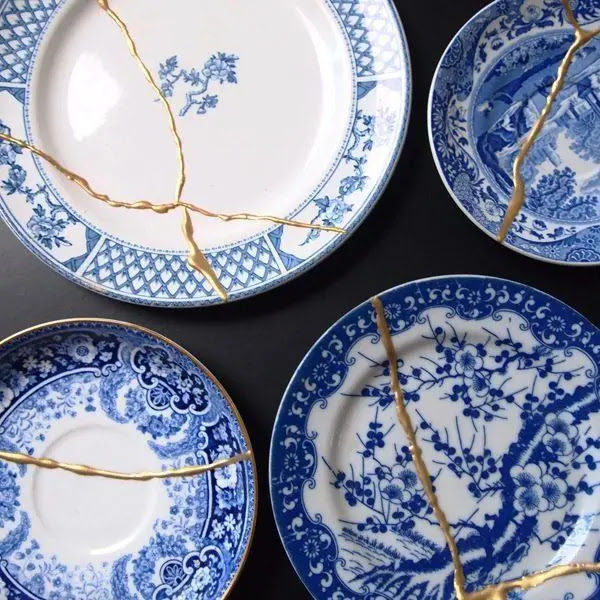
 Kintsugi is a way of mending broken pottery in Japan with lacquer dusted with gold or silver powder. It is recognizing, allowing, acknowledging and celebrating a crack or what might be seen as a flaw, but is an imperfection that joins all humanity... we are all imperfect which is part of what MAKES us human. I believe we are in this human life to grow and expand which requires some kinks along the way, and maybe even some suffering... so our suffering can be purposeful, which is encouraging and reminds me to be with suffering so that it is not wasted. It contributes to my heart's expansion and compassion. 


One nice excerpt from this article:

Today, extremely strong and barely visible epoxies and other repair compounds exist – but none add value to the pottery the way kintsugi does. If the perfect repair is done and the pottery looks as good as new. That is well and good, but it is also no better than a brand new mass produced item.

Again, same for humans. With age comes experience. With failures comes wisdom. Instead of hankering for a clean slate, forever wishing to take back one’s old mistakes, grasping for something different, we should instead highlight ourselves, flaws and all in large bold gold letters and become more beautiful for it.

In doing so, by practicing the philosophy that kintsugi so perfectly encapsulates, we find that ourselves and our lives suffice and is innately wonderful.


Saturday, March 5, 2016

Kumartuli and the Art of Deity-making in Kolkata, India


In Northwestern Kolkata, close to the Hoogly River (part of Holy Mother Ganga river), is a neighborhood of deity-makers, Kumartuli, long honoring the traditions of West Bengal and India. I was there in the season of Durga Puja, seeing the preparations for the subsequent week's Laxmi puja. What an amazingly perfect time to feel the zeal and creativity of this most auspicious week for Bengalis in Kolkata. They are very proud of this tradition of Durga Puja which is celebrated bigger in this city than anywhere else in India.

I visited Kumartuli several times during the week of Durga puja in October 2015. One time at night, and one time at mid-day. Creation is happening at all hours, and generally the doors to the crafting workshops are open to those who want to see the process.

I fell in love with the partly-made deities. They seemed so vulnerable in their nakedness and half-made states. I saw the beauty of the creative process, which I loved photographing and sharing here.

While some deities are created alone with their vehicles, other structures are an assemblage of deities put together to represent the story and tradition of the puja. Laxmi's vehicle is the owl, and she is the Goddess of Fortune. She is celebrated on the third day of Diwali and traditionally devotees to her clean and decorate their homes with lights and finery. They prepare sweets to offer to her. They may also purchase new clothing (I saw lots of sales toward this at stores and markets). This encourages the blessings of wealth and prosperity for people honoring Laxmi in this way.

What I remember most about the season of Laxmi puja was the constant barrage of firecrackers and fireworks throughout the cities of Kolkata and Bodhgaya!

Photo Diary of Kumartuli:

A deity starts with a bamboo superstructure, holding wrapped twisted straw deity shapes.


Happy devotee posing with an early Laxmi. 


Then natural clay mixed with chopped straw is sculpted onto the straw form.


A layer of wet clay is added to carve and shape the final form with detailed features. See photo on left with the man behind, chopping the straw on a cutting board to be mixed in with clay? Also, see the mold in the foreground here. They use some molds to creat limbs and faces, I think. It was a rare sight to see a woman deity-maker!

Molding the final clay form, while another man chops straw on the cutting board... and dog scratches.


Very rare female artisan.

This Laxmi is ready for her hands, and her exterior clay layer is dry.

Then deities are very skillfully painted in layers. White underlayer, then beige skin, then painstaking detail of the face and neck. Each diety has her characteristic details. See the red in Durga's eyes.
Night time working, painting many Laxmii deities.
Laxmi's holy feet and her owl vehicle.

Frist layers of paint on Laxmi deities.


Handpainted Laxmi face. I saw many Durga deities with the 3 lines on the neck.


Traditional Laxmi with her owl.

My favorite: Durga's traditional yellow face. 

Next, deities are clothed, and hair is glued on. Lots of workshops have their specialty... 


And finally, customers come to the market to buy from their favorite deity makers, to take their deities home...  
Happy Customer taking Laxmi to the family home. 

Customer taking a Laxmi home while vendor secures deities in his cart. 

Customers cart off an extra large deity ensemble (Visnu and consort Laxmi) in their truck that was driving by in the narrow lane... for a Laxmi puja pandal in Kolkata.

Or artists take their deities to a market in another part of town!
Laxmi's on the cart to be taken to market.

Sweet Laxmis tenderly packed on a cart for the market. Hold on tight for the ride!
 I so admire the detailed craftsmanship that goes into each deity. Each is handmade, handpainted by skilled tradesmen who care about this critically important aspect of their spiritual culture. It must be an honor to be part of one of these deity-making families. Traditions and vocations like these are typically passed down within families. They live in this section of Kolkata, keeping busy most of the year with the succession of pujas for the rich Hindu traditions that make West Bengal such a rich place of faith, tradition, color and fesitivity.

#kolkata #durgapuja #laxmipuja #westbengal #india #deities #kumartuli #hinduism #devotion #hindu #durga #calcutta #travelindia #sacredindia

Tuesday, March 17, 2015

Malaysian Wayang Kulit Shadow Puppets

Last weekend I experienced my first Malaysian shadow puppet show in Gainesville, Florida, seeing “Wayang Kulit: The Shadow Play of Kelantan”, Florida.  The troupe was traveling in the USA giving a sampling of the art with a one hour demonstration. They are a group of villagers from the state of Kelantan that borders Thailand where much traditional Malaysian music originated. The shows are typically 3 to 5 hours long, and portray stories from the Ramayana,  This evening's tale was of Lord Rama's courtly attendants discussing security of the palace, and then Ravaan coming in to steal Lord Rama's wife, Sita. 


When I entered the space, there were rows of seats to the right, and a red carpet for floor-sitters to the left... just in front of the screen. I saw my friend Anna P. there, and I wanted to be there with her, right next to the stage. When I sat down, I looked up and saw the screen, rows of puppets, and a young Malaysian drummer child sitting on the stage behind the screen. I smiled at the whole scene with child-like joy! I waved at him with a little wave and a big smile, feeling so excited that I was going to experience this traditional, original, unbroken lineage of ritualistic honored sacred art of telling religious stories for the enlightenment of the community they live in. He smiled back. As we all waited for 10 or 15 minutes, we kept looking at each other... and smiling. There was a very old man directly behind him (see pic) that we later learned is one of the masters, in his mid 70s. 
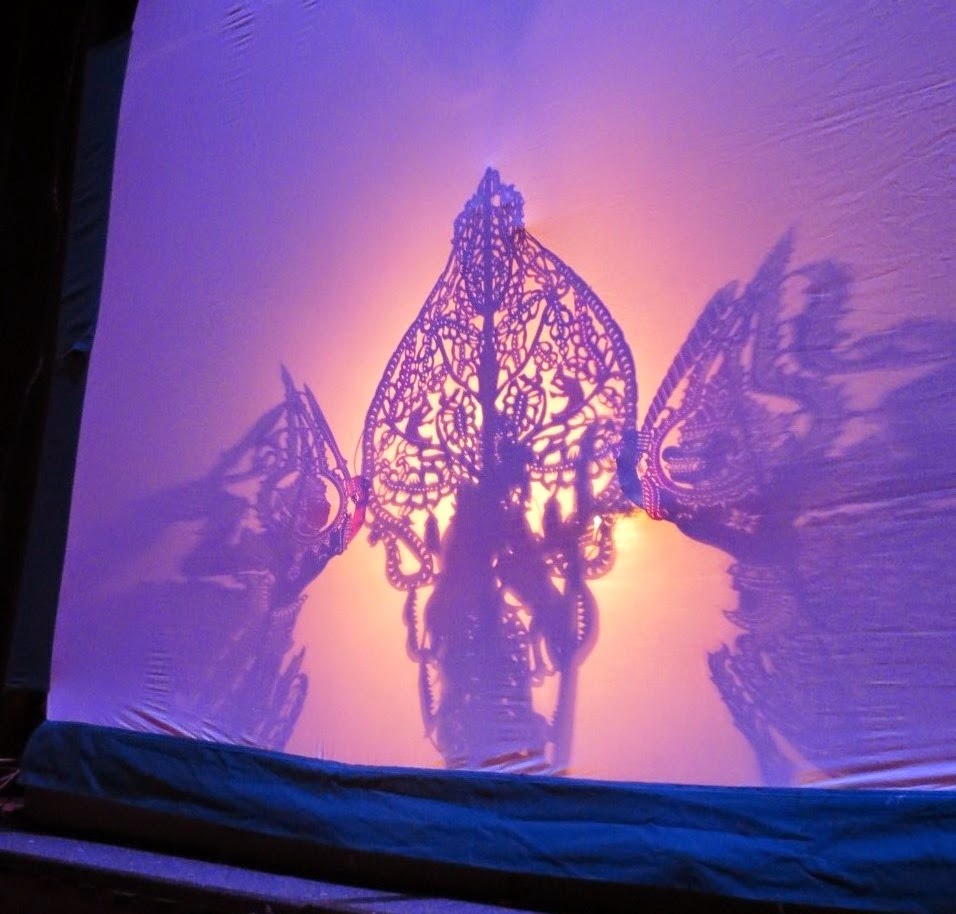


There was a second projection screen to the left of the puppet screen where a few sentences were listed in English to explain each scene.  They were quite general and did not reflect dialogue or drama. 


The show opens up with the tree of life and two celestial swordsmen protecting the tree of life. In Malaysia there would be prayers and rituals to start the show.  


As I watched these large images moving on the screen, I was so curious about how the puppeteers were moving the puppets back there. Were they in the floor? Why couldn't I see their hands or arms? The projection on the fabric was so sharp. 

 I was mesmerized by the drumming... there was a flute that was like a snake charmer. It was mesmerizing actually... Later we heard that after hours, some viewers go into a trance. It might be part of this spiritual art.

There is one puppeteer called a Tok Dalang (puppet master) who maninpulates all the puppets and says all the dialogue. Wayang means 'theatre,' and kulit means 'skin.'  The large puppets are made of buffalo skin, and I think a stick of horn is a rib doing down the length of each puppet giving it the strength to stand up to the movements.

I was craning my head to see behind the screen to figure this out... I was in awe of all the colorful puppets... The director was sitting on the edge of the raised stage where the musicians were sitting behind the puppeteer. He signaled with his finger, beckoning me to come back there. I turned round to see if he was speaking to someone else. There was nobody else... He beckoned again... I pointed at myself, he nodded, yes, come... I stood up halfway and went to where he was, and he said "You don't have to sit in one place. You can move around." 

So I kneeled there in total awe of the spectacle I was witnessing, and the incredible light and color of the Tok Dalang, his puppets, the light hanging in front of his face. the rows of puppets next to him. The musicians. I was heartbroken that no photos were allowed. Would I be able to find this on google, I wondered?  But I just enjoyed, and watched with awe as the puppeteer grabbed a puppet from a block of florists' green styrofoam. A palace perhaps... and he'd stab it into the styrofoam in front of him with quick deft confidence, because he had two other puppets that needed to get fighting! Those, he would swoosh across the screen, pressing the top to the screen, and swining the bottom part a little more so they moved in an arc across the screen, with the top more sharply projected than the bottom. It created an amazing movement affect for the audience, and was pretty simple... 

I stayed there a while and a few other folks from the floor came over, Anna first... then Kathy S. come from the seats to come see. More people came. I watched as my 13 year old drummer friend helped the puppeteer find the right puppets when needed from the puppet block in front of him... I never got to talk to my drummer friend... his older brother and mother are also musicians.


So while there is one puppeteer, there are 8 musicians (4 masters, and 4 young students ages 13 to 24 or something). They were playing barrel drums, gongs, cymbals and an oboe. 


I went back to watching from the front. I loved the music. Can I find a recording of that? I thought about making shadow puppet shows with elephant stories. I wondered if American puppeteers were ever producing these traditional shows to keep this art alive.  


After the show, the director talked, and the assistant director, a Malaysian woman answered most of the questions. They were so relaxed and nice, staying with us for almost an hour, answering questions and discussing. I asked about the tree of life coming back during some times in the play. They said it was used to represent the forest. I asked about other puppeteers doing this work in our out of Malaysia. There are only 3 troupes left doing it and no artists outside Malaysia doing it like this.  


I asked about the relationship between the Tok Dalang and his puppets... I wanted to know about this man's personal experience. The director answered in general that there is a relationship... the woman answerd that the puppets are a community and all travel together, even if the won't all be used in a show. And some are there and never used at all but stay with the group. They showed us a puppet that was almost 200 years old. They talked about the main master that was so famous that died not too long ago. 


I wanted to show these puppets to people. I wanted to make a show with a good story, and singing that people would enjoy while seeing the artistry of these puppets. I wanted to have ritual and the tree of life in the show, to create awareness, consciousness and reverence for all that we do.  

Tuesday, March 12, 2013

Soil Landscape Art to Radiolab

I wrote a letter to Radiolab the other day... they wrote back saying the idea of patterns in nature is a good one and that the idea would be forwarded on. It was from a nice intern.  Here is my letter:

Hello RadioLab!
I am a spatial analyst, water science communicator, crafter, puppeteer and wetlands soils naturalist that has discovered amazing beauty in soil patterns at large spatial scales, by adding color and combining 2-dimensional layers of land descriptors in my computer system.

I can envision these beautiful images hanging in a big office lobby in San Francisco or Portland... or lined along a wall of my local organic-foods restaurant. I have made art with nature! But across many miles.
I realize: the mesmerizing patterns that I often notice in decaying leaves or on the tummies of turtles, are as beautiful across a watershed or several counties, knowable with color-coded aspects of soils; recognizable when looking at maps of patterns of characteristics of something that is under us all the time, though covered by lawn, pavement or forest. And the two must be related - patterns of the small with the patterns of the land. Is there a law about this, or just intuition?
It is fun to picture, the lone tawny soil scientist, who, maybe in the 1950s, worked days on end, traveling a region - auger in hand - to map what was under us: how fast it drained, the colors of the layers, the minerals and organics making up the soil. Who would have guessed that their interpolated curves and polygons would have yielded such colorable muralable art that speaks to my deep sense of natural harmony that I feel when I see so many patterns in life, that we emulate in on our socks, wallpapers and upholstery? Maybe my socks don’t have a river running through them as you see in these images attached.
I want to attract someone to the art of the image and when they are admiring the red-brown serpentine shapes, tell them about the ancient trace of a river that has disappeared.
I wrote to you because I think of you as someone who appreciates how science has so much art in it, especially in the form of patterns. Let me know if we can make a show about something like this. Or maybe you know of a site/community that would be into these kinds of images and linkages and the amazingness of patterns in nature at lots of scales.
Much admiration for your ideas and expression,
Kathleen McKee

Tuesday, October 20, 2009

Soils Art


I stumbled upon this art as I perused a digital elevation model layered over a soil drainage map around the Santa Fe River and Suwannee River confluence.

It made my heart jump.


Friday, October 16, 2009

Strangers in Awe

This past year I experienced strangers hugging and kissing me; one held my upper arms in their clutch with eyes of amazement and awe transfixed on mine. It was a look of disbelief or of having discovered a big secret.

Last weekend we performed our “Carp Diem” shadow puppet show for the 4th time in public. This time it was really public, in one of the louder more crowded bars of Gainesville, Durty Nelly’s, with about 180 people that night. It’s an Irish Pub (as Irish as they get in SE USA) and we were part of a lineup for a CD release party which included 3 other bands, a belly dancer and a comedy act. Our refrigerator box – haphazardly painted black, with a semi-square opening papered over in white – couldn’t have looked very promising sitting on stage in the din of the semi-drunk crowd that had recently booed the comedy act off the stage. But oh, what an accordion can do to get folks’ attention. It announces that the show is beginning, then stops.

The fishmonger-lady shadow puppet appears, and things get quiet. Her clogs, stripey ragged outfit, poochy tummy and sagging breasts in bright colors of red, marine blue and rusty orange show her nebbish nature brightly on the screen (see below). I begin my slow, alto, a cappella “I’ve been a fishmonger all my life... because no man will take me as his wife…” The crowd is still hushed. The dancing-man shadow puppet pulling on his beard comes out with fish and buxom silhouettes of ladies and mermaids following him around. The goddess of the sea (we use the deus ex machina quite literally) Indonesian rod puppet supplies the magic flying sturgeon that strikes him in the head and wakes him up to his love of our fish-throwing heroine.

All ends in frenetic love with good amounts of spluge and ecstasy. Big applause and cheering climaxed with our puppets. I’m a bit nervous to show myself after being safely hidden in my box with Kathy Sohar, my puppet partner. Rob tells me to bow; the audience is standing, clapping and cheering, so I semi-curtsey, bow off the stage.

I am again surprised by the intense amazed reaction and love of our little show. Their was no electronica, lights, explosions or fast fast anything, just paper, lights and lyrics. I guess we made them feel something they didn’t know they were going to feel when they first saw that ramshackle refrigerator box.

Note: our show has still not been loaded to YouTube, but it will be coming soon.

Sunday, October 11, 2009

Mediterranean (or Aegean) Shadow Puppets

I've always been interested in puppetry arts and I must have voiced this enough such that a friend who went to Thessoliniki to work on his PhD research on greek religious iconography 10 years ago returned with 2 articulated colorful shadow puppets made of plastic with very unique styles and personalities that made me think these were particular characters from a certain Greek tradition of story telling. Another clue was the packaging listing their names: XATZLABATHS (below) and ΑΓΝΑΪΑ (right). Both labels had greek words:


ΚΑΡΑΓΚΙΟΖΙΔЄЅ
ΤŏΜΟΛΛΑ


I've been trying to find the origins of these quiet storytellers and I believed they may be characters in the stories of Haridimos Karaghiozi, the well-known Greek shadow puppet tradition which was being kept alive and well by puppeteer story teller Evgenios Spatharis who sadly died after falling down stairs this past May on his way to a performance. He recorded 18 Karaghiozi stories on 78 records long ago. Luckily, another puppet artist Sotiris Haridimos keeps the tradition going in Athens with his Karagiozis Theater on Tripodon Street.

I found this photo of a record on UK's ebay and translation is provided showing same greek word that is on my puppet label with translation "To Miralogi Tou Karagiozi." So my puppets must be the characters of Karagiozi plays, yay, I solved the mystery!

Today I stumbled on the Cegniz Turkish shadow puppets; look how similar they look to the greek ones! It makes sense, Turkey and Greece are close neighbors.


Not sure about their language commonalities. On the webpage for the Cegniz shadow puppets they mention a play about environmental stewardship based on the shamanistic sources of Karagöz! Wow, these 2 traditions are more closely related than I thought, this is getting more interesting!


For the Greeks, Karagiozi is a representation of the struggles of the Greek peoples, especially in reference to Turkish occupation. Wow... . The main character has a hunchback and one arm 3 times longer than the other. He schemes to get things by acting roles of socially important people to gain small things, and the stories are full of historical and societal references that make Greek audiences laugh, purportedly.

In Turkey, Karagöz is the name of the traditional shadow puppetry tradition as well as the name of one of two characters portrayed in the traditional shadow puppet plays. He represents childlike, uneducated morality and common sense; a tactless little man (whereas the other main character Hacivat represents the ideals of the ruling classes during the Ottoman empire and gets irritated at Karagoz for ruining their fun).
In both traditions, this Karagiozi/Karagöz character is an underdog opposed to authority and sultanic powers. And so it seems that a long tradition in Turkey preceded the tradition in Greece for these shadow puppets. It makes sense because the Turkish tradition supposedly started at a contstruction site in 1396 by two guys sick of seeing corruption of ruling classes over the working man... and the Ottoman's began to rule Greece in the 15th Century. When did Karagiozi begin in Greece? This blogger's posting tells that it was in the 19th century (along with a lot of other neat shadow puppet history).

Darn! In May 2009 they had a shadow puppet festival in Istanbul with all the Cegniz puppets, and I missed it!