Search This Blog

Showing posts with label Asia. Show all posts

Saturday, January 16, 2016

Sick Dogs of Bodhgaya

I received amazing news yesterday and am feeling so happy and grateful! A sick dog in India that I spent 2 days trying to capture to take to hospital has been treated for cancer and released by Dogs of Gaya


I had stayed in Bodhgaya for weeks and saw him 4 times on the road sitting helpless, sad and weak with a terrible open wound around his testicle area that he continually licked. When I heard about an animal hospital (Maitri Foundation) a few km away, I went there to get help. After pleading, phone calls and the promise of donating, two men took me back to town in their dog-catching jeep to find the dog and bring him for treatment. That day we couldn't find him.

The next morning I found him and took him breakfast and called the men back to meet me with their jeep. But the dog ran and ran in fear.


One man chased and chased for an hour, and I ran around town looking for the man chasing the dog. One nice tuktuk driver helped me get around (he had taken me to the dog hospital the day before, waited with me that morning for the jeep and men, gave me a tea... he was eager to help with my dog rescue). I was in and out of the tuk tuk, and in and out of the hospital jeep. I tried to coax that fearful sick dog. We had to give up for the day.

I was leaving town the next morning. I felt worried about this dog. I named him Balaram! I figured that might help the Maitri Foundation want to help this pet even after I left town. Why was I so attached to getting help for this dog?

Yesterday I messaged Dogs of Gaya (an NGO that helps dogs on the streets in that area) and learned that they got the dog to the annual Kagyu Monlam Animal Medical Camp where they fixed an infected tumor he had. The dog is now healthy, playing, and happy to be pet and cuddled!

So many dogs in India are forced to live at the literal margins of society. They can't live in the road, or will be run over, and are eschewed from the sidewalks by people doing business there. They must literally live on that line where the road meets the edge. They live on this thin line of nothingness, hoping for a scrap of food, and avoiding the cars and scooters that drive within inches of their bodies. Many do get hit or run over and suffer with the injuries or die. 

I am so very glad and grateful to the amazing things Dogs Of Gaya is doing for a very needy population of loving emotional beings who are neglected. I saw some people shouting at them or hitting them with sticks, but mostly they are ignored. Luckily many people do get rid of old leftovers by leaving them on the ground for the dogs or cows. Interestingly, dogs usually stay in the same area to live. This dog stays in front of the Thai temple on the main road.

When I would walk and see stray dogs, I would bend down and talk to them in a friendly way. Most would look up and wag their tails a bit, looking hopeful. I would pet those dogs, and they would stand up and get all happy. Most want some love and attention. After all they are domesticated animals, not meant to be living out on their own alone. If they did not wag the tail I would leave those dogs alone. I saw so many mangy and undernourished dogs. The weaker ones will lose opportunities to eat food and are treated even worse by people, being seen as a source of sickness.

Dogs of Gaya really represents the important Compassion in Action that His Holiness the Dalai Lama talks about! 

Please donate -- www.dogsofgaya.org

‪#‎bodhgaya‬ ‪#‎mahayana‬ ‪#‎dogrescue‬ ‪#‎dogs‬ ‪#‎india‬‪ #‎animalrescue‬ ‪#‎animallove‬ ‪#‎compassion‬

Tuesday, March 17, 2015

Malaysian Wayang Kulit Shadow Puppets

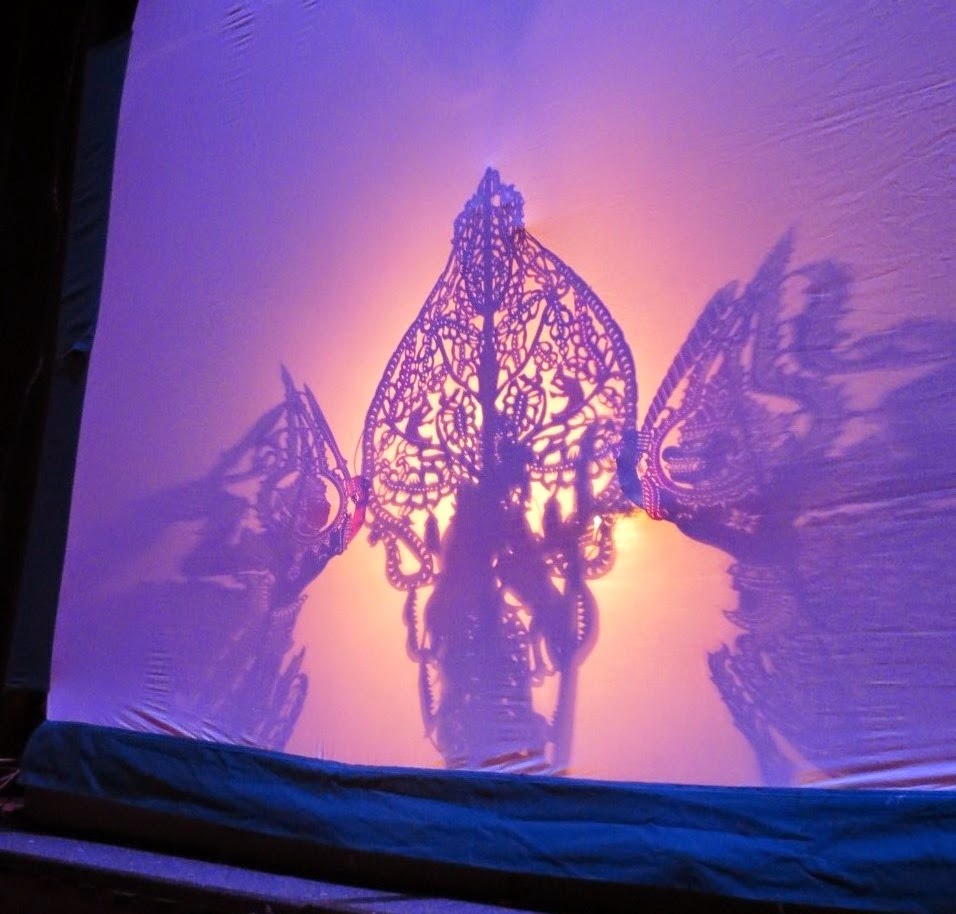
Last weekend I experienced my first Malaysian shadow puppet show in Gainesville, Florida, seeing “Wayang Kulit: The Shadow Play of Kelantan”, Florida.  The troupe was traveling in the USA giving a sampling of the art with a one hour demonstration. They are a group of villagers from the state of Kelantan that borders Thailand where much traditional Malaysian music originated. The shows are typically 3 to 5 hours long, and portray stories from the Ramayana,  This evening's tale was of Lord Rama's courtly attendants discussing security of the palace, and then Ravaan coming in to steal Lord Rama's wife, Sita. 


When I entered the space, there were rows of seats to the right, and a red carpet for floor-sitters to the left... just in front of the screen. I saw my friend Anna P. there, and I wanted to be there with her, right next to the stage. When I sat down, I looked up and saw the screen, rows of puppets, and a young Malaysian drummer child sitting on the stage behind the screen. I smiled at the whole scene with child-like joy! I waved at him with a little wave and a big smile, feeling so excited that I was going to experience this traditional, original, unbroken lineage of ritualistic honored sacred art of telling religious stories for the enlightenment of the community they live in. He smiled back. As we all waited for 10 or 15 minutes, we kept looking at each other... and smiling. There was a very old man directly behind him (see pic) that we later learned is one of the masters, in his mid 70s. 


There was a second projection screen to the left of the puppet screen where a few sentences were listed in English to explain each scene.  They were quite general and did not reflect dialogue or drama. 


The show opens up with the tree of life and two celestial swordsmen protecting the tree of life. In Malaysia there would be prayers and rituals to start the show.  


As I watched these large images moving on the screen, I was so curious about how the puppeteers were moving the puppets back there. Were they in the floor? Why couldn't I see their hands or arms? The projection on the fabric was so sharp. 

 I was mesmerized by the drumming... there was a flute that was like a snake charmer. It was mesmerizing actually... Later we heard that after hours, some viewers go into a trance. It might be part of this spiritual art.

There is one puppeteer called a Tok Dalang (puppet master) who maninpulates all the puppets and says all the dialogue. Wayang means 'theatre,' and kulit means 'skin.'  The large puppets are made of buffalo skin, and I think a stick of horn is a rib doing down the length of each puppet giving it the strength to stand up to the movements.

I was craning my head to see behind the screen to figure this out... I was in awe of all the colorful puppets... The director was sitting on the edge of the raised stage where the musicians were sitting behind the puppeteer. He signaled with his finger, beckoning me to come back there. I turned round to see if he was speaking to someone else. There was nobody else... He beckoned again... I pointed at myself, he nodded, yes, come... I stood up halfway and went to where he was, and he said "You don't have to sit in one place. You can move around." 

So I kneeled there in total awe of the spectacle I was witnessing, and the incredible light and color of the Tok Dalang, his puppets, the light hanging in front of his face. the rows of puppets next to him. The musicians. I was heartbroken that no photos were allowed. Would I be able to find this on google, I wondered?  But I just enjoyed, and watched with awe as the puppeteer grabbed a puppet from a block of florists' green styrofoam. A palace perhaps... and he'd stab it into the styrofoam in front of him with quick deft confidence, because he had two other puppets that needed to get fighting! Those, he would swoosh across the screen, pressing the top to the screen, and swining the bottom part a little more so they moved in an arc across the screen, with the top more sharply projected than the bottom. It created an amazing movement affect for the audience, and was pretty simple... 

I stayed there a while and a few other folks from the floor came over, Anna first... then Kathy S. come from the seats to come see. More people came. I watched as my 13 year old drummer friend helped the puppeteer find the right puppets when needed from the puppet block in front of him... I never got to talk to my drummer friend... his older brother and mother are also musicians.


So while there is one puppeteer, there are 8 musicians (4 masters, and 4 young students ages 13 to 24 or something). They were playing barrel drums, gongs, cymbals and an oboe. 


I went back to watching from the front. I loved the music. Can I find a recording of that? I thought about making shadow puppet shows with elephant stories. I wondered if American puppeteers were ever producing these traditional shows to keep this art alive.  


After the show, the director talked, and the assistant director, a Malaysian woman answered most of the questions. They were so relaxed and nice, staying with us for almost an hour, answering questions and discussing. I asked about the tree of life coming back during some times in the play. They said it was used to represent the forest. I asked about other puppeteers doing this work in our out of Malaysia. There are only 3 troupes left doing it and no artists outside Malaysia doing it like this.  


I asked about the relationship between the Tok Dalang and his puppets... I wanted to know about this man's personal experience. The director answered in general that there is a relationship... the woman answerd that the puppets are a community and all travel together, even if the won't all be used in a show. And some are there and never used at all but stay with the group. They showed us a puppet that was almost 200 years old. They talked about the main master that was so famous that died not too long ago. 


I wanted to show these puppets to people. I wanted to make a show with a good story, and singing that people would enjoy while seeing the artistry of these puppets. I wanted to have ritual and the tree of life in the show, to create awareness, consciousness and reverence for all that we do.