Search This Blog

Showing posts with label Africa. Show all posts

Saturday, June 29, 2013

My Old Ignorance of the Elephant Spirit

I read the book the Elephant Whisperer by Lawrence Anthony, and was so moved, awed and shocked by the interactions and society of the elephants including their long-distance communication and ESP-type perception. The book is an autobiography of Anthony's chapter in life of saving a unruly herd of elephants that required many sleepless nights camping by an enclosure (a boma) to
stay close to the distrustful group as they got accustomed to their new place and to him. He spoke to them often so they would feel his intentions after a time. He spared no expense to build a serious fence to protect them from poachers and from villagers whose fields, if trampled, would give them license to kill.  Once out of the boma, they tested the big fence, wanting to go back to their original home. They knew the direction to go and made a run for it once. A skilled helicopter pilot herded them back, and saved their lives doing it.

Over some years, he and the herd got to know each other. I could not put this book down, learning about the social lives of the elephants and for the connections he created with his soft patient presence with individual elephants as he would encounter them in their daily routines during his cruises through the property. The elephants finally recognized that place as home.

When Anthony died suddenly of a heart attack in Europe, the elephants traveled 12 hours to get to his house a day or 2 later in S. Africa. They had not been there  in three  years. They stayed there, near the fence around the house, for two days. Maybe they were saying goodbye... showing their appreciation and trust with Lawrence... or maybe they were performing a funeral rite. I cried for their sorrow, their unity in emotion, their acknowledgement of their friend and I cried for the beauty and realization of the magic of these beings. I felt almost betrayed, that this aspect of elephants - belonging to a level of beings with that type of consciousness was not in my ken, much less common knowledge as I felt it should be.

They stayed present with his spirit, his passing and their intention to honor him... and maybe with their own sadness. It seems that the elephant is more present and honoring of a death than we are. This event alone has put me on a path of creating change for elephants and learning more and more about them.

We all know dolphins communicate and in India they were recently declared dolphins to be non-human persons: “[Their] unusually high intelligence as compared to other animals means that dolphin should be seen as ‘non-human persons’ and as such should have their own specific rights and is morally unacceptable to keep them captive for entertainment purpose.”

I implore India to do the same for their own native Asian elephant. Can all nations do this for dolphins, elephants and  primates? Will that make a difference to all the killing that is happening for the sake of ivory in Chinese markets? Can we then move to respecting all animals and giving them respect and space to be? 

When will we see that we are not superior to other animals? When will we break free of our egos and superiority complex and realize we have become frail and ignorant of earth which is our source of life and connection to everything?

I am happy that elephants are still alive and that so many people are working hard to protect them from the killing that is rampant right now, as the demand for ivory is very high in China. I know we can change it.

source: http://www.beliefnet.com/Inspiration/Home-Page-News-and-Views/Wild-Elephants-Mourn-Death-of-famed-Elephant-Whisperer.aspx?p=1

Tuesday, August 30, 2011

Making Millet Beer, Malwa

I was going through my Uganda trip notes, and found the recipe I wrote down for Malwa, the millet beer people make behind their house. Luckily, this man had the beer prep process in multiple stages at once (so as not to ever run out) and showed us the process and instrumentation involved in making and drinking with his buddies!

The word for millet is bulo.

1. they dry it in the sun
2. remove the husks by beating it with a stick and winnowing.
3. when clean, grind it using a grinding stone
4. ferment for 1 week
4a. dig a hole
4b. put in banana leaves
4c. put in soil
4d. add the millet
4e. add more soil
4f. cover with banana leaves
5. roast it
6. dry it in the sun
7. put in water and yeast
8. next day, add more yeast and water
9. third day, it is ready!
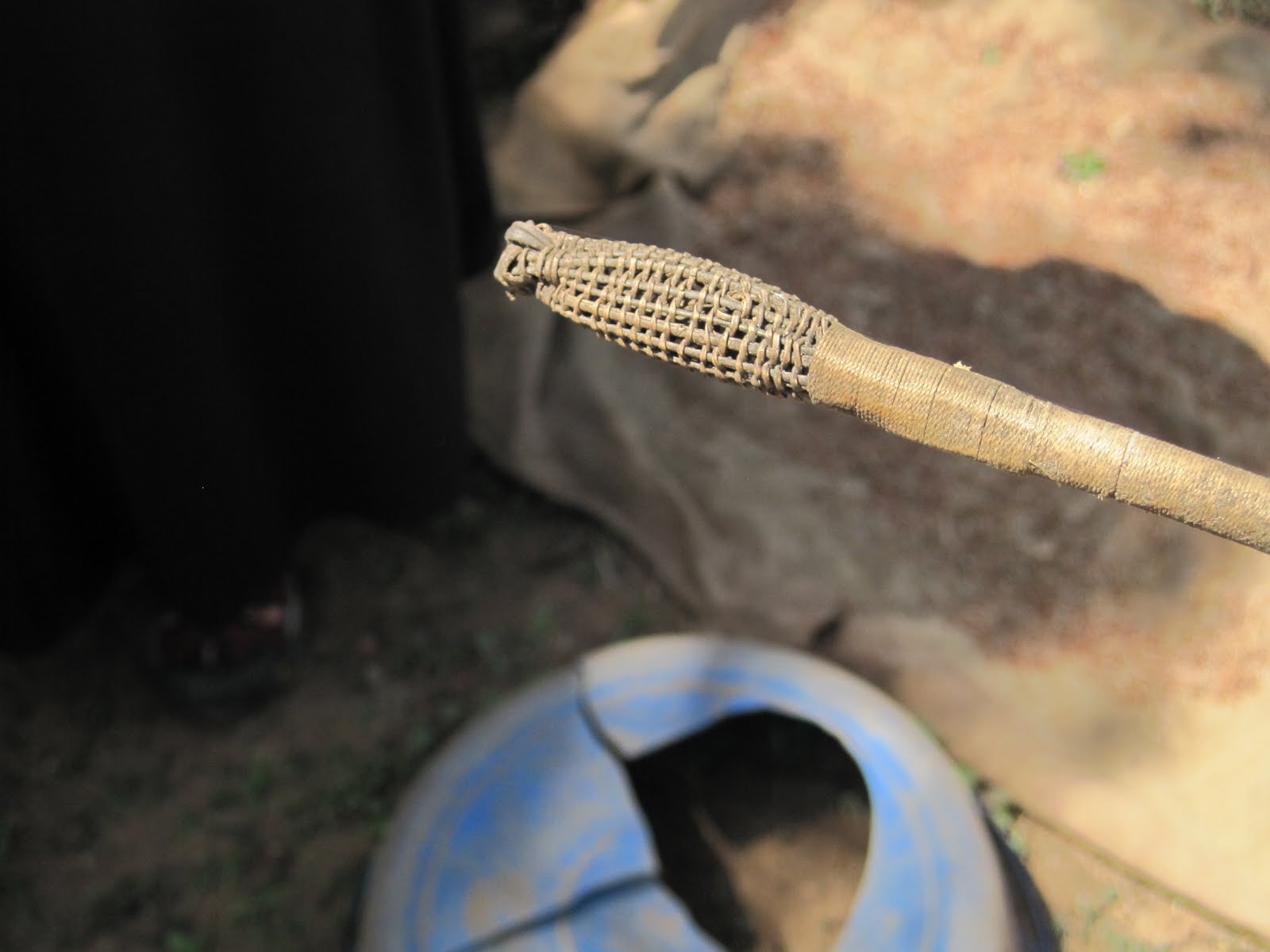
10. make a long straw (see photos)
11. drink with your buddies standing around the pot together, who bring their own straws!


Apparently they make their own yeast too:

Take clean millet after drying and put in water. Put in a cloth sack to drain. It will start to germinate. Turn it and turn it for 4 days. 5th day dry in the sun. Grind. Now this is yeasty millet flour to use in the malwa!

Just read a news story online, a guy got caught stealing his neighbor's malwa pot! As punishment, they made him drink the whole pot, but he vomitted before he was halfway through! http://allafrica.com/stories/201107180396.html


Friday, April 9, 2010

In Uganda...

After 3 weeks there, I observed that in Uganda...

  • they don't eat lunch

  • they are very patient and don't need to discuss what is about to happen...

  • they love African tea (hot milk, ginger, teabag)

  • they say 'ehhhh' or 'heyyy' to acknowledge listening or sympathy and 'mmmm' to mean yes or listening

  • women wear long skirts

  • they have a soft handshake, and gently point to or grasp their right elbow with their left hand
  • they wear fabrics with bright interesting attractive patterns!
  • women don't squat and never sit on the ground cross-legged
  • they ride boda boda bikes to get a cheap lift
  • they eat much bananas (matooke)
  • they grow casava, beans, bananas, sweet potatoes
  • Stoney and Novida are popular softdrinks
  • they don't put screens on windows or doors but give out free mosquito nets
  • rural folks get water from borehole wells with hand pumps and yellow jerry cans
  • they use bicycles to transport matooke, water, firewood and charcoal
  • their bikes are all similar heavy metal bikes
  • charcoal is made from acacia and sold in towns, while country folk use firewood
  • bugandans kneel to elders
  • babies have beads around their waists and seldom any pants or diapers
  • there are many babies
  • they don't use donkeys, mules or horses for transport or farming and few machines, just human muscle for work
  • they live out much of their lives in front of their house
  • there are certain fruit reserved for children (jack fruit, tamarind, mango?)
  • people speak english
  • they sweep the dirt with little small hand-made/held brooms
  • children love to see mzungu, say the word and giggle and wave
  • cows in towns often look healthier than cows in the countryside
  • there are lots of cows
  • people are uncynical
  • people usually have Christian names: Frank, Grace, Evelyn, Andrew, Gilbert, Isaac, Hilda, Moses, Francis, Lawrence, Elizabeth, Daniel
  • women put wraps around their heads to keep dust from the road out of their hair
  • women wear lesu wraps around their waists to keep their dresses clean
  • clay content of soils is 39 to 59% so they turn their land into bricks and homes

Sunday, January 24, 2010

The Buganda Kabaka


The Baganda make up largest tribe in Uganda (map on right). The Bonyoro tribe is their biggest rival (map on left).

"At its founding, the Kingdom of Buganda had only a small territory consisting of the counties of Busiro, Busujju, Kyaddondo and Mawokota; as well as small portions of Ssingo and Bulemeezi counties. Most of the surrounding territory was the dominion of the kings of Bunyoro. There was considerable rivalry between Bunyoro and Buganda, and constant fighting over territory. Gradually, Buganda was able to expand its territory at the expense of Bunyoro until it grew to the twenty counties that constituted Buganda at its pinnacle. The islands of Ssese [in Lake Victoria] were autonomous within Buganda right from its founding, being reserved as the islands of the gods. They were not directly governed by the kings of Buganda until after the 1900 agreement." Quoted from this site that has the list of Buganda counties, the chiefs and how acquired the counties.

The Baganda honored a king, the Kabaka. The last Kabaka was Mutesa II. His full name was Major General Sir Edward Frederick William David Walugembe Mutebi Luwangula Mutesa II aka "King Freddie." He died in 1969 in exile in London from alchohol poisoning, unable to return to his homeland where Obote was ruler.

Mutesa II became the King of Buganda in 1939 upon the death of his father. He attended Magdalene College in Cambridge England where he joined an officer training corps and was commissioned as a captain in the Grenadier Guards. At that time, Buganda was part of the British protectorate of Uganda.

In the early 50s the Brits wanted to unite their colonies (Uganda, Kenya and Tanganyika) into a federation but people feared they would come under the control of Kenya's white settler community, as had happened in Rhodesia (now Zimbabwe). The Baganda had some limited autonomy under British rule so were particularly opposed. Mutesa confronted the British Governor, saying "no way!" The latter exiled the former in 1953, creating massive protest among the Baganda which pressured Brits to let him return in 1955. After a settlement was reached, he became constitutional monarch and gave the Baganda the right to elect representatives to the kingdom's parliament, the Lukiiko. Mutesa's standing up to the Brits sure made him popular!

Mutesa II's monarchist party was called the Kabaka Yekka party and was now quite powerful. Milton Obote was leader of the Uganda People's Congress and created a coalition with the Kabaka Yekka. In 1962 Uganda became independent from Britain under the leadership of Milton Obote. Through parliamentary elections, Obote became Prime minister and Mutesa II became the first president.

The coalition between Mutesa and Obote's parties collapsed in 1964 when two counties from Buganda were transferred to Bunyoro. Things got even worse, so in 1966 Obote sent the Kabaka into exile (a dingy little London flat) and declared himself president.

Mutesa II wrote an autobiography in London called "The Desecration of my Kingdom." I bet it is a very sad book. The Buganda people loved their king very much.

Idi Amin was ruler after Obote and he arranged for Mutesa II's body to be returned to Uganda two years after his death to have a state funeral in order to win favor with the Baganda people in preparation for the next election. I think it worked.

Kabaka kings are still crowned in Buganda, in a place just 20 minutes from Kampala called Naggalabi Buddo. Oh boy, it's now a tourist spot - costs $2 to get a look. But apparently there was an interegnum, where they had no king between Mutessa II and his eldest son Muwendi Mutebi II being crowned in 1993.


Saturday, December 12, 2009

Cattle Rustling in Karamoja

Karamoja is the dryest, poorest part of Uganda - with 80% illiteracy rate - in NE Uganda on the border with Kenya. Karimojong are the people - nomadic pastoralists competing across the Kenyan border with the Turkana nomadic pastoralists. Both rustle cattle across the border, a practice sometimes ritualized as a way to manhood, but fraught with violence as many gun-carrying men protect their herds which represent their wealth and symbolize their power in society. Kotido and Moroto make up the political area of Karamoja. Pastoralists from Kotido raid Kitgum to the east. Raiders from Sudan go into Kitgum. Raiders from Kenya (the Turkana) go into Kotido and Kitgum, and those guys go over to Kenya. These cows travel a lot. They bring diseases with them, foot and mouth disease is one.

Karimojong have had the belief that cattle naturally belongs to them so they can take more. In the 1980s they acquired guns from unhappy national army soldiers, and so began the gun culture. All this raiding brings a big demand for guns, so the Turkana, Karimojong and Sudanese are expert arms dealers specializing in inexpensive guns. They are expert marksmen too.

They don't want to wear western clothing but Idi Amin tried to make them. In 1972 Amin had 200 Karimojong shot for choosing not to wear western clothing. Now they wear sarong things, and army jackets I read somewhere.

The "Magoro accord" was sealed back in 1998 between Karimojong and the neighboring Teso tribe. If you kill someone in a raid and people find out, the government will take 60 of your cattle and give it to the victim's clan.

In June 2009, the Ugandan army sent out some troops as the cattle anti-theft force to protect the border between Kitgum and Kotido, and protect Kitgum from Sudanese too.


NY times story from 1991

Amazing timeline of Gun History in Karamoja